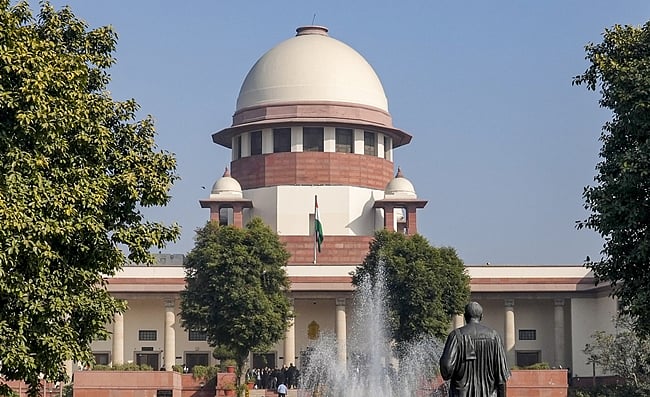
The Supreme Court on Wednesday imposed an interim stay on the Madras High Court order appointing a five-member committee to oversee the administration of the Chidambaram Nataraja Temple.
A bench comprising Justices Aravind Kumar and Vipul Pancholi, which heard the appeal filed by the Dikshitars, stayed the High Court’s October 30 order.
The central issue in the case is whether devotees should be allowed to climb the Kanakasabai mandapam at the Chidambaram Nataraja Temple to have darshan, or not. Kanakasabai is the elevated hall in front of the Nataraja sanctum. Certain rituals are usually performed there. Complaints arose over devotees being denied permission to climb up there for darshan.
After investigating those complaints, the Cuddalore District Collector recommended in 2022 that devotees should be allowed to climb the Kanakasabai and worship. Based on that, the Tamil Nadu government, through a government order on May 17, 2022, granted permission to climb the Kanakasabai and have darshan.
However, the hereditary trustees, the Dikshitars, who have the traditional right to manage the temple, filed cases in the Madras High Court, claiming that this government order infringed upon their right to administer religious affairs. On the other hand, some petitioners also filed cases insisting that they should be allowed to climb the Kanakasabha and have darshan. Their argument was that, since the temple is a public place of worship belonging to the public, everyone should be given an equal opportunity for darshan.
In this case, in its judgment delivered on October 30, 2026, the Madras High Court upheld the 2022 government order that permitted Kanakasabai darshan. It said that the government order does not interfere with the rituals of the Dikshitars; it only regulates the public darshan system.
In the same judgment, it found accounting irregularities in the temple administration, unauthorized constructions, and damage to ancient sculptures and murals, and ordered the formation of a 5-member committee to oversee the administration. The court directed that board to immediately take over the administration until the deficiencies are rectified.
In this five-member committee, retired Chennai High Court judge V. Bharathidasan was to serve as the chairperson, retired judge R. Suresh Kumar as the co-chairperson, and retired IAS officer C. Rajendran as a member. The Secretary of the General Dikshitars and the Secretary of the Hindu Religious and Charitable Endowments Department were to function as ex officio members.
In addition, this committee was given the powers to regulate the darshan system, oversee the management of temple funds, and recover temple-owned properties. The High Court left the responsibility for conducting daily worship rituals and the occasional festivals to the Dikshitars themselves.
Following this, an appeal was filed in the Supreme Court on behalf of the Dikshitars. During the hearing of this case in the Supreme Court on Wednesday, senior advocate C.S. Vaidyanathan, appearing for the Dikshitars, argued that the High Court had gone beyond the dispute over access to the Kanaka Sabha and removed them from there without setting a deadline for restoring the Dikshitars’ control.
He also rejected the claim that the Dikshitars were responsible for changes made to temple structures and the like. It was also stated that the Dikshitars had submitted audited accounts.
Following this, the judges granted an interim stay on the order of the Madras High Court, directed the respondents, including the Tamil Nadu government and the Hindu Religious and Charitable Endowments Department, to file their response within 6 weeks, and adjourned the hearing to 12.1.2027.